
Air Duct Cleaning: Repair or Replace? How Williamsburg Homeowners Decide
Most homeowners facing a duct replacement quote are being asked to decide based on how the ducts look. That’s the wrong test. Ducts get replaced when a technician sees crushed flex or peeling tape, and ducts get repaired when everything looks tidy, yet the opposite can be true in both cases. The real question isn’t age or appearance, it’s whether the system can be restored to a sealed, functional state, and the only way to know that is with a pressure test, not an eyeball estimate.
If you’d rather not sort that out on your own, call (833) 508-9915 for a free estimate.
Why a Duct Leakage Test Beats a Visual Judgment Call
A duct leakage test measures how much conditioned air escapes the system under pressure. The test is run with a calibrated fan that pressurizes the ductwork and a gauge that reads the loss. That gives you a number, and a number is something you can act on.
The two common methods are a blower door test (which pressurizes the whole house and tells you how leaky the envelope and ductwork are together) and a duct blaster (which pressurizes the ducts alone and isolates the leakage to the system). A duct blaster result is the one that matters most for a repair-or-replace decision, because it tells you how much of your air is being lost into unconditioned space.
Here’s why this matters in Williamsburg specifically. Flex duct that looks flattened and sad can still pass a leakage test if the inner liner is intact and the connections are sealed. Sheet metal that looks brand new can be leaking badly through failed mastic seams that aren’t visible from the register. We’ve seen both. The visual assessment gets it wrong in both directions.
A leakage test gives you a threshold. In general terms, if the measured leakage is modest, sealing and repair will bring the system into a healthy range. If the leakage is severe and the loss is concentrated in buried runs, replacement of specific sections or rerouting may cost less than chasing leaks you can’t access.
The Failure Modes That Favor Repair
Most duct problems in Williamsburg homes are repairable. The failures that respond well to targeted repair usually fall into three categories:
- Failed mastic seams. The sealant at joints has dried, cracked, or peeled away. Air leaks at the joint, not through the duct wall. Re-sealing the seam is fast and durable when the duct is accessible.
- Disconnected flex sections. Flex duct comes apart at collars and boots. Reconnecting, re-taping with the right tape, and re-supporting the run fixes it. This is the single most common leak we find.
- Collapsed liner. The inner lining of insulated flex duct can sag and restrict flow. If the liner is torn or collapsed in a section, replacing that section is the fix, not the whole system.
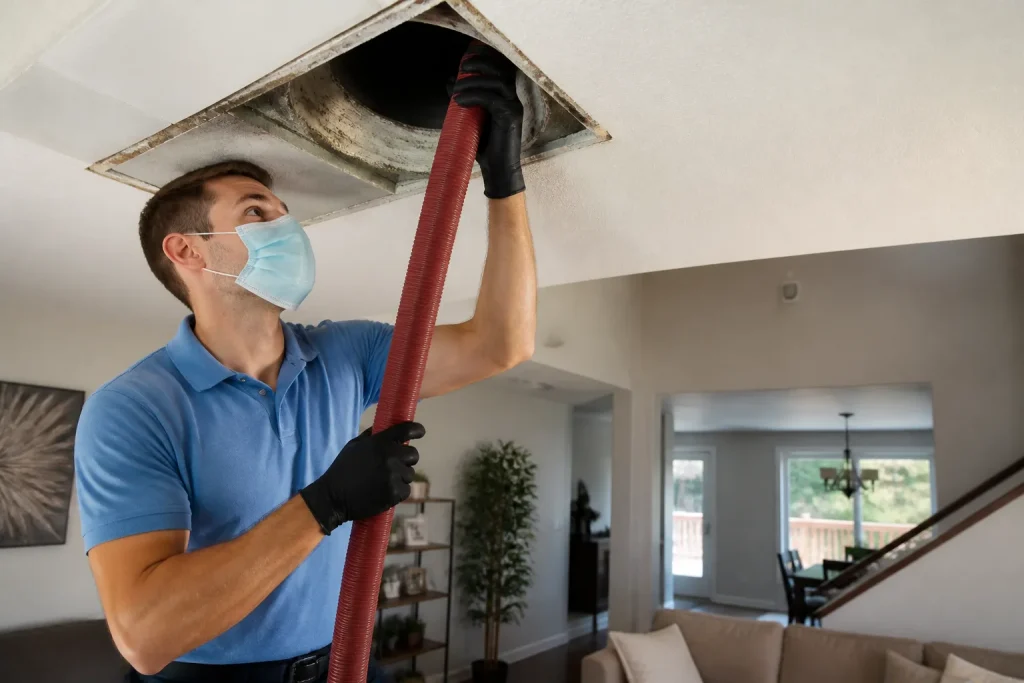
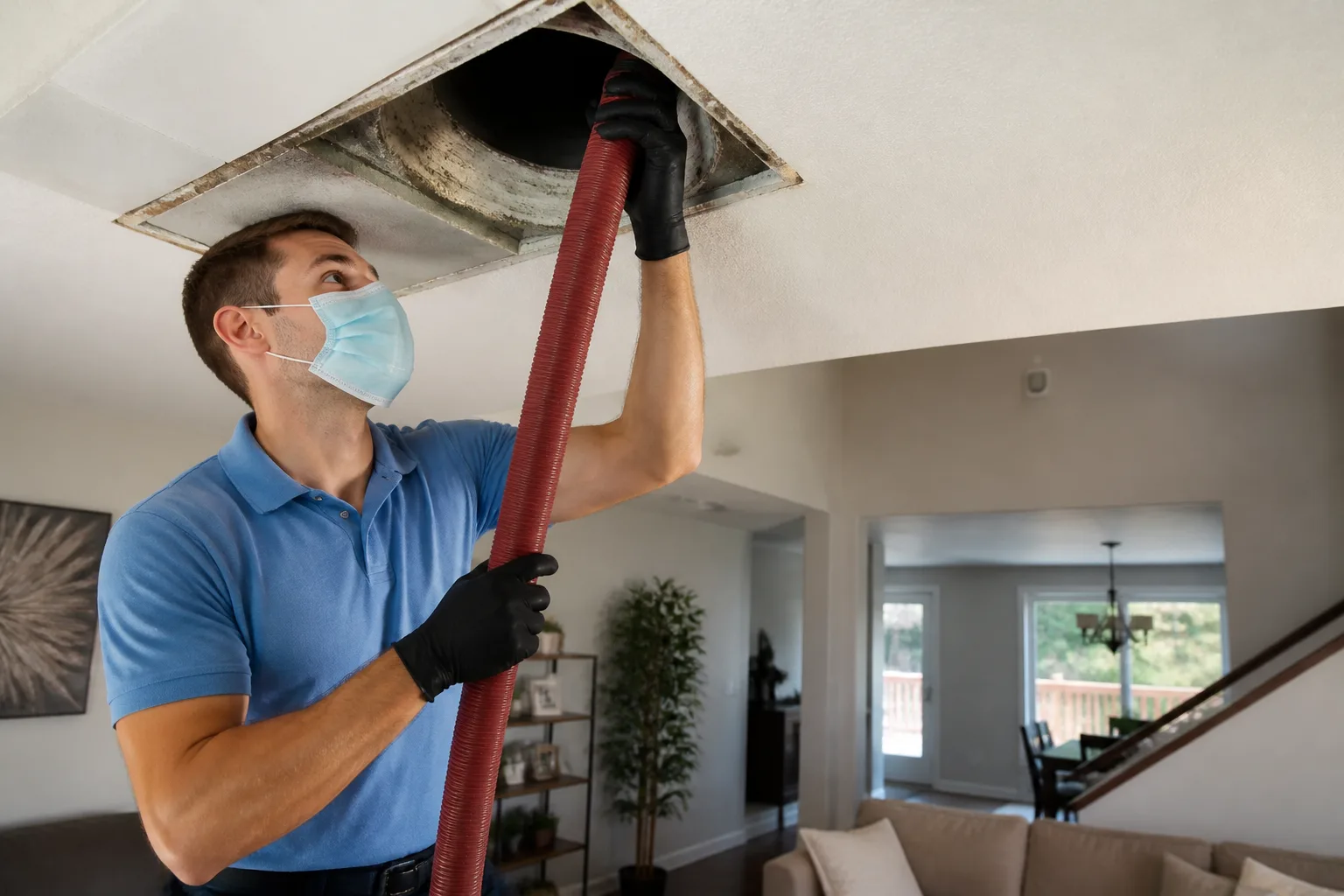
These repairs are mechanical and accessible in most cases. With an air duct cleaning visit, we identify the leaks while we’re already in the system, then repair and seal so the cleaning actually holds. Clean ducts with leaky seams don’t stay clean.
The Failure Modes That Justify Replacement
Replacement makes sense when the system can’t be brought back to a sealed, functional state at a reasonable cost. That usually means one of the following:
- Crushed main trunk. If the primary trunk line is crushed or collapsed over a long run, there’s nothing to seal. The duct has to be rebuilt or rerouted.
- Asbestos-wrapped duct. Older duct wrapped in asbestos-containing insulation is a hazard to disturb. In most cases a professional abatement contractor has to be involved, and replacement is often the simpler path.
- Undersized system-wide layout. When the duct layout was sized for a smaller system or was never balanced to begin with, spot repairs won’t fix the comfort problem. A reroute or redesign is the actual solution.
None of these should be declared from a visual walkthrough alone. A crushed trunk is visible, but the extent of the loss needs a pressure reading to confirm replacement will actually solve the problem. We use Rotobrush rotary brush cleaning alongside Nikro negative-air equipment during service, which lets us inspect and clean the system without cross-contaminating the home, and the inspection findings feed directly into the repair-or-replace call.
How Williamsburg’s Building Types Change the Math
Williamsburg is not a uniform housing stock. The building type you live in changes which option makes financial sense, and it changes it more than most homeowners expect.
Industrial conversions. Loft-style conversions often have exposed ductwork running along ceilings or in open plenum space. Exposed ducts are cheaper to access, cheaper to repair, and cheaper to test. In these buildings, spot sealing and section replacement are almost always the better call, because the labor cost of getting to the duct is low.
Finished ceilings. Ducts buried above drywall or plaster ceilings are a different story. Every repair requires an access cut, patching, and repainting. Three or four access cuts can cost more in drywall work than replacing the affected run with new, properly sealed duct. In these homes, replacement of a section often beats chasing multiple repairs behind finished surfaces.
This is why a Williamsburg homeowner and a contractor can look at the same duct problem and reach opposite conclusions. The duct isn’t the variable. The cost of access is. It’s also why we always walk the building layout before recommending anything: the same leak in two different buildings can have two different answers.
Spot Sealing vs. Section Replacement vs. Full Reroute
Here’s the cost framework we use when we can’t just eyeball the answer. The numbers below are typical ranges, not quotes. The written estimate you receive sets the final price.
| Tier | What it involves | Typical range | When it fits |
|---|---|---|---|
| Spot sealing | Re-sealing seams, reconnecting flex, re-taping collars | $250 – $600 | Isolated leaks, accessible duct, modest leakage test result |
| Section replacement | Replacing a defined run of flex or sheet metal | $600 – $1,800 | Collapsed liner, crushed section, buried duct with several leaks |
| Full reroute | Rebuilding the trunk and branch layout | $1,800 – $4,500+ | Undersized layout, crushed main trunk, asbestos-wrapped duct |
The energy savings math behind each tier is simple. Sealed ductwork keeps conditioned air inside the system where you paid for it. That recovery is what justifies the repair spend, and the leakage test tells you how much is being lost before you commit. If the test shows a small loss, spot sealing recovers it quickly. If it shows a large loss concentrated in one buried run, section replacement wins. If the whole layout is wrong, a reroute is the honest answer.
What to Get in Writing After a Repair
This is the part most homeowners skip, and it’s the part that protects you. After any duct repair, ask for a post-repair leakage test result. It’s the only proof that the work actually improved the system.
The result should be a measured number you can compare to the pre-repair test. If a contractor seals seams and then tells you it’s fixed without re-testing, you don’t have confirmation, you have a claim. We run the test before and after, and the numbers go into the report along with before-and-after photos of the ducts themselves so you can see what changed.
If the repair included an air quality step, ask what products were used. Abatement Technologies filtration equipment is a common part of our service lineup because it addresses contamination beyond surface dust, and Guardsman-grade cleaning and protection products feature in the sanitizing step. Having those names in the report lets you verify what was actually applied, rather than trusting a one-line invoice.
Related services in Williamsburg
Duct work is one part of the air system. If your dryer vent is also a concern, we handle dryer vent cleaning as a separate service, and for whole-system work we carry out HVAC cleaning so the ducts, coils, and air handler are addressed together. If the decision on your system is still open, start with the main air duct cleaning Williamsburg service page for an overview of what we do.
When to Call a Pro
If you’re staring at a duct quote and the technician hasn’t run a pressure test, that’s the moment to call someone who will. Visual inspection is a starting point, not a decision. A system that looks bad can be sealed and saved, and a system that looks fine can be bleeding conditioned air through seams you can’t see.
If your ducts run behind finished ceilings, call before you authorize any access cuts. The building layout often determines whether repair or replacement is the better financial path, and it’s worth having that conversation before the drywall gets opened. Our technicians have up to 13 years of experience, and the local pro is licensed and insured as their state requires. Call (833) 508-9915. We answer 24/7. Fast dispatch from 7am to 7pm, Sunday through Friday.
The Bottom Line
Repair wins when the duct system can be brought back to a sealed, functional state, and that answer needs a pressure test, not a walkthrough. Failed mastic seams, disconnected flex, and collapsed liner in accessible duct are repair jobs. A crushed main trunk, asbestos-wrapped duct, or an undersized layout make replacement the honest recommendation. In Williamsburg, the building type changes the math: exposed ducts in conversions are cheap to repair, and ducts buried in finished ceilings often make replacement the better financial call. Get a post-repair leakage test in writing and you’ll know the work actually helped.
If you’re in Williamsburg and need help, Air Duct Cleaning Williamsburg offers free estimates – call (833) 508-9915. One flat price per system agreed before work starts, no per-vent pricing, and before-and-after photos of your own ducts.
Frequently Asked Questions
Not reliably. Visual degradation and actual leakage don’t track each other, so a flattened flex run may pass a pressure test while tidy sheet metal with failed seams leaks badly. A duct leakage test is the only way to make an objective call. Call (833) 508-9915 for a free estimate – estimates are free.
Spot sealing typically runs $250 – $600, section replacement $600 – $1,800, and a full reroute $1,800 – $4,500 or more, as general ranges. The written estimate sets the final price. In our experience, the building type moves the number more than the duct itself does. Call (833) 508-9915 for an exact quote – estimates are free.
Ask for a post-repair leakage test result and compare it to the pre-repair number. A sealed system should test tighter than it did before. If a contractor won’t re-test after the repair, you have no proof of improvement. Before-and-after photos of your own ducts are the other check. Call (833) 508-9915 for a free estimate.
Yes, in most cases. Cleaning makes the leaks visible, and any repair should be paired with cleaning so you’re not sealing contaminated ductwork. Sealing a dirty system just traps the contamination inside. Our cleaning, repair, and sanitizing steps run together for that reason. Call (833) 508-9915 for a free estimate.
Written by the team at Air Duct Cleaning Williamsburg.
Need Air Duct Cleaning Help?
Call Air Duct Cleaning Williamsburg - the local pro we connect you with is licensed and insured, with free written estimates in Williamsburg.
(833) 508-9915