
How to Choose the Right Air Duct Cleaning Company in Williamsburg
Any company can put NADCA certification on a website. What they can’t fake is showing up with a negative-pressure vacuum rated for the cubic footage of your system. The fastest way to separate a real duct cleaning contractor from a coupon operation in Williamsburg is to ask one question before you book: what equipment are you bringing, and does it match the scope you’re quoting? If the answer is vague, the quote is probably vague too. If you’d rather not spend your week vetting strangers, call (833) 508-9915 and we’ll walk you through what a proper job involves.
Why Williamsburg Attracts Low-Barrier Duct Cleaning Operators
Williamsburg packs a lot of residential units into a small footprint. Dense multi-unit buildings, converted lofts, and older walkups mean thousands of HVAC systems stacked close together, which makes the neighborhood look like easy money to anyone with a shop vac and a Craigslist ad. The barrier to entry in this trade is low: no license exam for duct cleaning specifically in most cases, no equipment minimum, no inspection requirement. So a company can print “certified” on a business card and start booking calls the same week.
That density cuts two ways. It also means the contractors who actually invest in professional equipment – rotary brush systems, HEPA filtration, negative-air containment – stay busy in Williamsburg because building managers and homeowners talk to each other. Word travels fast in a walkup. The operators who cut corners don’t last long once a co-op board or a landlord catches on. Your job is to figure out which type you’re talking to before they pull up.
The scale of what you’re dealing with matters too. A single-family brownstone with a full basement trunk line and a dozen supply runs is a different job than a two-bedroom rental with a compact system and four vents. A contractor quoting by vent count isn’t pricing your system; they’re pricing a template. That’s the first clue.
The Equipment Questions to Ask Before You Book
Equipment is the one thing a phone call can verify. Ask these three questions directly, and listen for specifics. Vague answers (“we use professional equipment”) are a red flag; brand names and ratings are not.
- What’s the CFM rating on your vacuum? CFM (cubic feet per minute) tells you how much air the unit moves. A truck-mounted or high-capacity negative-pressure unit pulls far more than a portable shop vac. If the person on the phone can’t tell you roughly what their vacuum is rated for, they either don’t know their own gear or don’t have serious gear.
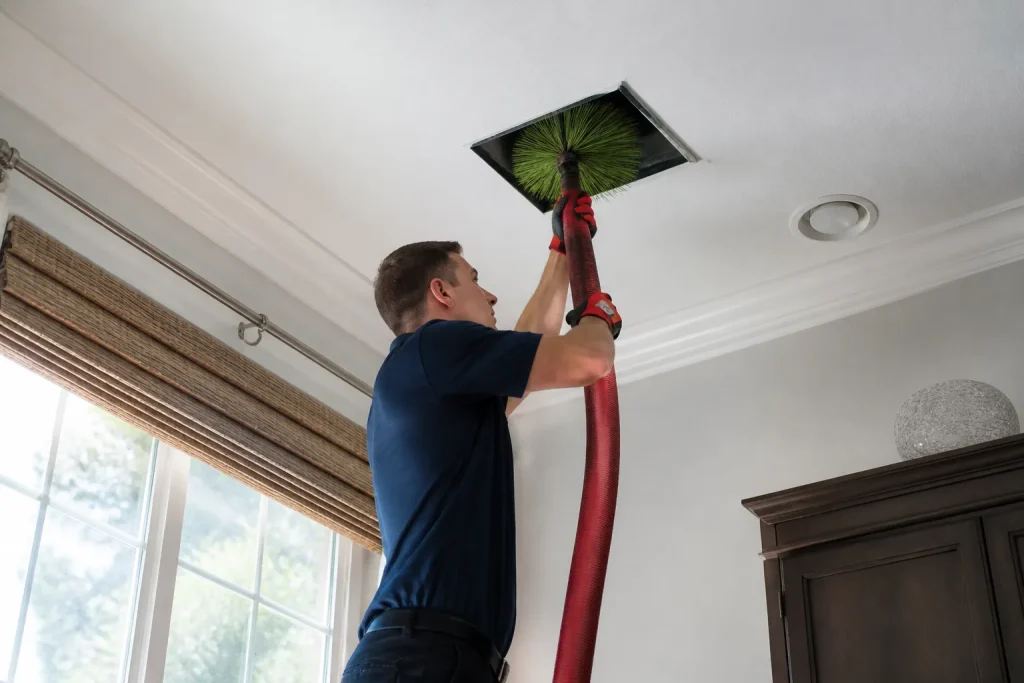
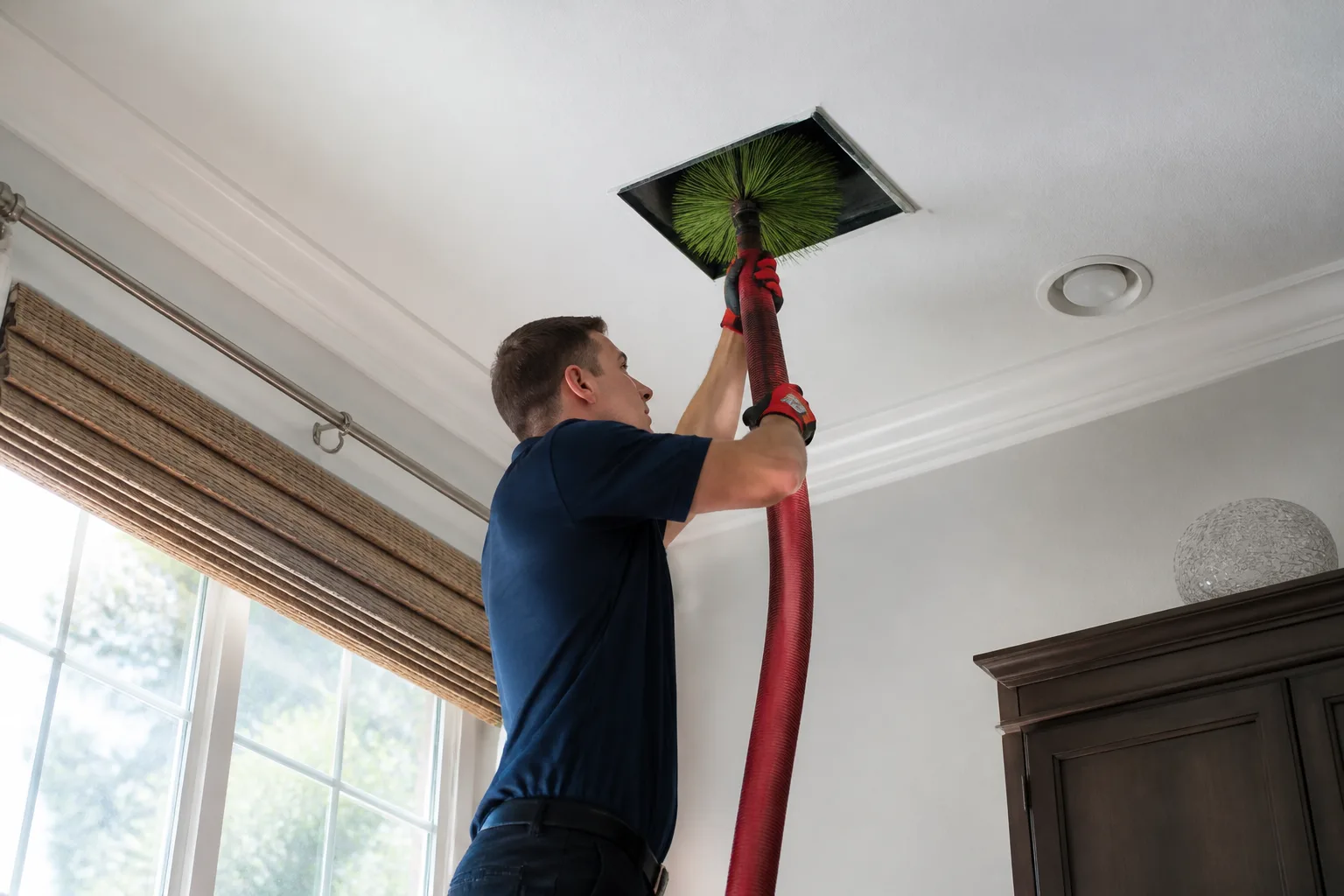
- What kind of brush system do you use? Rotary brush systems like Rotobrush are the industry standard for mechanical duct cleaning because they agitate the duct walls and pull debris loose rather than just sucking at the surface. Ask if they use a rotary brush or a whips-and-cable setup. Both can work; neither is a shop vac.
- Do you carry a camera for pre- and post-inspection? A camera lets you see the inside of your ducts before the job and after. If a company doesn’t inspect before and after, you have no way of knowing whether anything changed. That’s not a small gap.
We use Rotobrush rotary brush systems and Nikro negative-air equipment, and we run Abatement Technologies filtration on jobs that need it. Those aren’t marketing words. They’re the same categories of equipment remediation contractors rely on, and they’re why the answer to “what are you bringing” is specific rather than a shrug.
NADCA Membership Is a Floor, Not a Ceiling
NADCA (the National Air Duct Cleaners Association) membership and its associated certification are legitimate signals. They mean the company has at least engaged with industry standards for how duct cleaning should be done. But membership alone doesn’t tell you what equipment they own, how they price, or whether they’ll actually inspect before and after. Plenty of coupon operators hold a certification and still show up with a portable vacuum.
So treat NADCA as the baseline, then look for what sits above it:
- Remediation-grade capability. Does the company handle contamination beyond surface dust – microbial growth, odors, particulate – or do they stop at vacuuming? A contractor who carries HEPA filtration and sanitizing products can address problems a basic cleaner can’t.
- Repair and sealing on the same scope. Most standalone duct cleaners clean and leave. If they can’t identify and fix leaks in the ductwork, the system will pull debris back in through the gaps within a season. Cleaning without sealing is a temporary fix.
- Air quality products they actually work with. A contractor who carries Honeywell or Aprilaire filtration lines can recommend and install upgrades at the point of service. That suggests they’re thinking about the system, not just the vacuum hose.
- Before-and-after documentation. Photos from inside your own ducts, not a stock gallery on the website.
For a fuller picture of what a proper air duct cleaning job covers, it helps to know what the process should include before you start comparing quotes.
How to Evaluate a Quote: By System Size, Not Vent Count
A legitimate duct cleaning quote is priced by the size and complexity of the system, not by the number of vents. Vent count is easy to count and easy to pad. System size involves trunk line length, the number of returns, access difficulty, and whether the ductwork is accessible in the basement or buried in a wall. Those are the variables that actually determine labor and equipment time.
When you get a quote, look for these markers:
- A written, itemized estimate. One flat price per system, agreed before work starts. Not a per-vent price that changes once the technician is on site.
- Questions about your system. A real quote starts with questions: how many returns, how old is the system, any recent moisture or mold issues, is the ductwork accessible? A quote that comes without questions is a guess.
- Scope spelled out. Cleaning, inspection, repair, sealing, sanitizing – each should be a line, not a bundle called “the works.”
- No teaser number. That $99 coupon isn’t a price; it’s a foot in the door. The real invoice shows up after the technician has been on site for an hour.
Pricing in Williamsburg reflects the housing stock. Older buildings with long trunk runs and tricky access take more time than a newer unit with a short, simple system. A company that quotes the same flat rate for every address in the neighborhood either hasn’t looked at your system or is planning to make up the difference on site. Ask what the estimate is based on. The answer tells you a lot.
Red Flags That Show Up During the Job
The sales call is the easy part. The real test is what happens once the equipment is inside. Watch for these, and know that you have the right to stop work if any of them appear:
- No containment. A proper job uses negative air pressure and plastic sheeting to keep debris from blowing into living spaces. If the crew starts pulling vents with no containment, that’s a problem.
- No camera, no inspection. If they never opened a camera or showed you the inside of a duct before and after, you have no evidence the work happened.
- Scope creep in real time. A sudden “we found mold” or “your ducts need sanitizing” mid-job, with a new price attached and no visual evidence, is the classic bait-and-switch. Ask to see it on camera before agreeing to anything.
- The vacuum doesn’t match the quote. If the quote described a truck-mounted unit and a portable shop vac shows up, stop the job.
- Pushy add-ons. Air quality upgrades should be a recommendation with product names and a written price, not a pressure sale at the door. Honeywell and Aprilaire products are worth discussing – but at your pace, not theirs.
If a crew won’t show you before-and-after photos of your own ducts, you have your answer. The work either didn’t meet the standard or wasn’t done. Either way, you’re within your rights to stop and ask for the written estimate to be honored or the job called off.
When to Call a Pro
Duct cleaning isn’t an annual ritual. If your vents are visibly dusty, if you’re seeing a spike in allergy symptoms indoors, if you notice musty odors when the system kicks on, or if you’ve just moved into a Williamsburg building with unknown duct history, it’s worth a professional inspection. If you’re dealing with a dryer that takes two cycles to dry a load, that’s a separate safety issue – dryer vent cleaning is a fire-risk item, not a convenience one. And if your HVAC system itself hasn’t been cleaned as part of the duct job, HVAC cleaning covers the coils, blower, and components the ducts connect to.
You can also read more about our broader air duct cleaning Williamsburg process and what a typical visit involves. One call can cover cleaning, repair, sealing, and air quality upgrades, which means you’re not coordinating three contractors.
The Bottom Line
Choosing a duct cleaning company in Williamsburg comes down to asking better questions than the next person. Verify the equipment by name and rating. Confirm that the quote is priced by system, not vent count. Check for pre- and post-inspection with a camera. Treat NADCA membership as a starting point and look for repair, sealing, sanitizing, and air quality capability above it. And know that you can stop the job if the crew in your home doesn’t match what was quoted over the phone.
Our technicians have up to 13 years of experience with professional-grade equipment, and we quote one flat price per system before work starts. If you’re in Williamsburg and want a straight answer about what your system actually needs, we offer free estimates – call (833) 508-9915. We answer 24/7. Fast dispatch from 7am to 7pm, Sunday through Friday.
Frequently Asked Questions
It depends on system size, accessibility, and whether repair or sealing is needed. A company that quotes by vent count with a teaser price is likely to adjust the invoice on site. Ask for a written, itemized estimate priced per system. Call (833) 508-9915 for a free estimate – the written quote sets the final price.
Because they often don’t include the equipment a real job requires – negative-pressure vacuum, rotary brush system, camera inspection, and containment. A cheap quote is usually a per-vent number that grows once the technician arrives. When you compare quotes, compare equipment and scope, not the headline number. Call (833) 508-9915 to talk through what a proper job includes.
Ask for before-and-after photos from inside your own ducts. A company using a camera will have them; one that doesn’t won’t. That’s the simplest verification available, and it’s the one we build into every job. Call (833) 508-9915 for a free estimate.
Not on a fixed calendar. It depends on your system, your building, visible dust, odors, and any recent moisture issues. An inspection tells you more than a schedule does. If you’re unsure, call (833) 508-9915 and we’ll give you a straight answer – free estimates, no pressure.
Written by the team at Air Duct Cleaning Williamsburg.
Need Air Duct Cleaning Help?
Call Air Duct Cleaning Williamsburg - the local pro we connect you with is licensed and insured, with free written estimates in Williamsburg.
(833) 508-9915